


 Video
Video Iranian regime seems to be 'very dug in' on talks with US: Ben Domenech
A 'Special Report' All-Star panel analyzes where the U.S.-Iran talks stand and more.
The U.S. military has assembled one of its most substantial concentrations of naval and air power in the Middle East in decades — a force structured not for a limited strike, but for sustained combat operations if ordered. While diplomats in Geneva trade proposals, the Pentagon has moved beyond a "show of force" to an operational footing that represents the largest concentration of U.S. air power in the region since the Iraq War era.
Two carrier strike groups now anchor the alignment.
The USS Abraham Lincoln is operating in the Arabian Sea, supported by Arleigh Burke–class destroyers including the USS Spruance, USS Michael Murphy, USS Frank E. Petersen Jr., and USS Pinckney.
Transiting the Mediterranean is the USS Gerald R. Ford strike group, escorted by the USS Bainbridge and USS Mahan. Once the Ford arrives in theater, the Navy will establish a dual-carrier strike posture rarely seen outside of major conflict.
Under high-tempo conditions, a single carrier air wing can generate more than 100 sorties in a 24-hour period, depending on tanker support and target distance. With two carriers operating in parallel, planners can sustain continuous strike cycles — rotating decks so that aircraft are launching from one carrier while the other re-arms and recovers.
That posture allows for sustained pressure over multiple days rather than isolated waves.
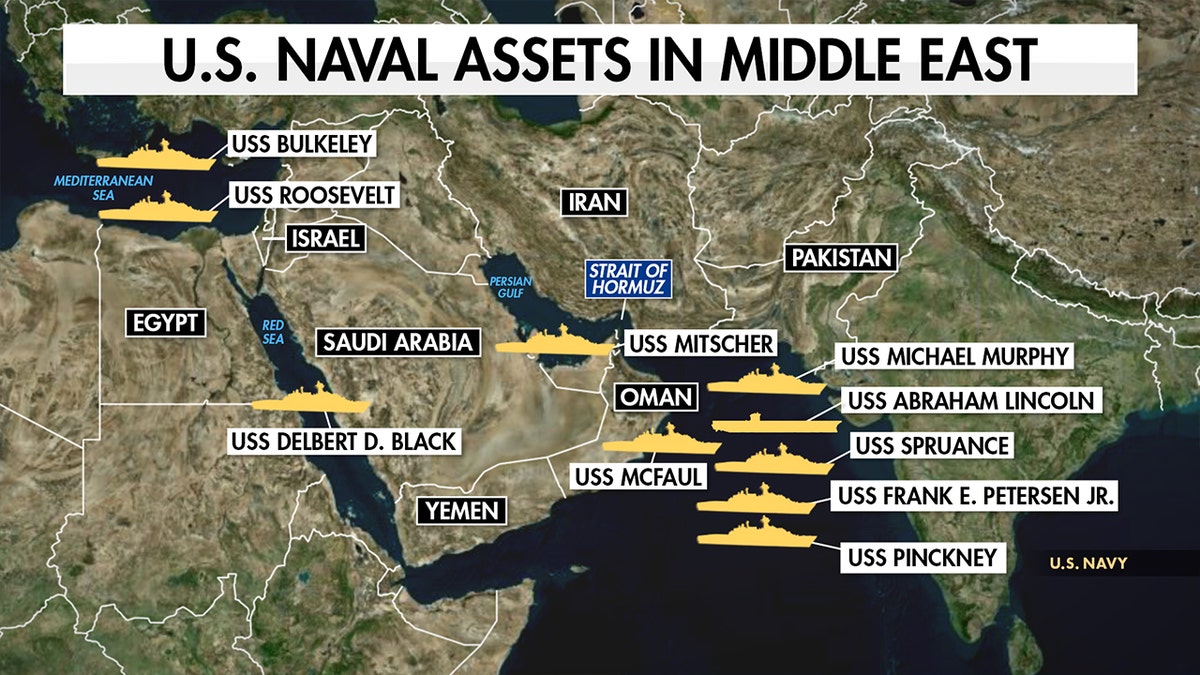
Map of US naval ships in the Middle East. (Fox News )

Steve Witkoff and Jared Kushner flew out to the USS Lincoln with Adam Cooper on Saturday, Feb. 7, 2026, according to officials. (CENTCOM/X)
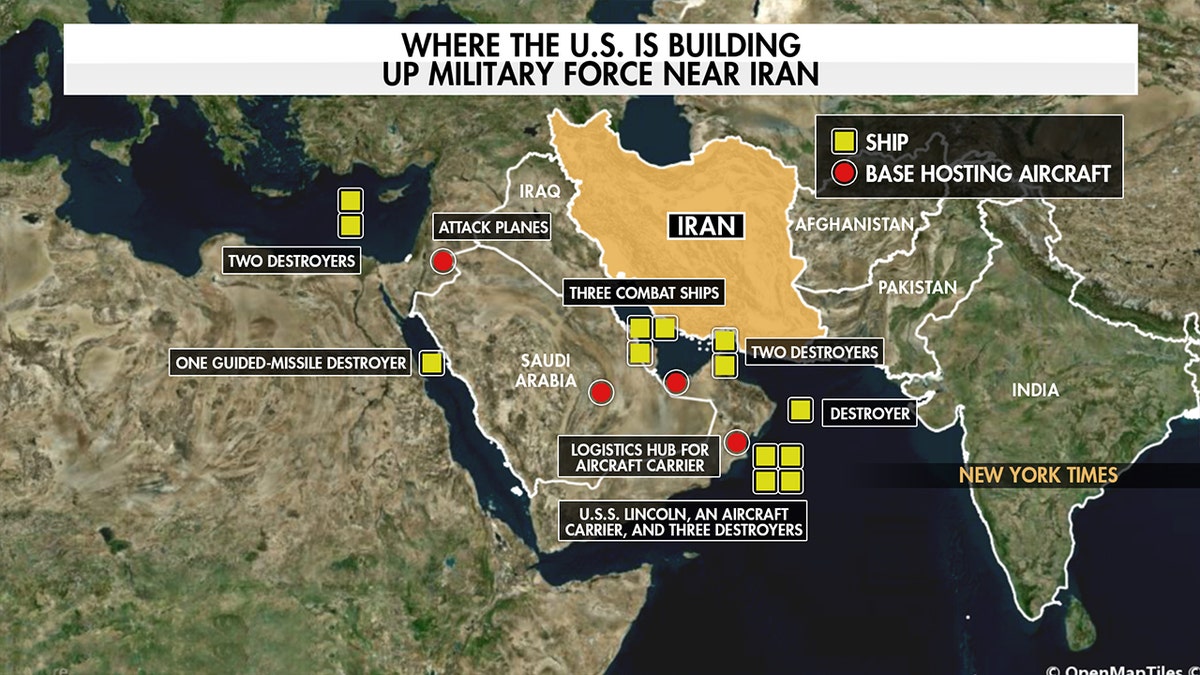
Map shows where the U.S. is building up military forces near Iran. (Fox News )
The buildup comes as satellite imagery reveals Tehran accelerating defensive preparations.
Commercial imagery published in a report by the Institute for Science and International Security (ISIS) shows Iran reinforcing the Taleghan 2 facility at Parchin with fresh concrete and overburden. Similar hardening is underway at tunnel entrances near Natanz.
"The core issue is all these efforts would complicate the battle damage assessment (BDA) in a post-strike environment," defense analyst Can Kasapoğlu said. Hardened subterranean targets require repeated "drill" strikes — multiple munitions on the same coordinates — followed by confirmation missions to determine whether facilities have been disabled.
That kind of campaign demands sustained sortie generation and deep munitions reserves.
WORLD'S LARGEST AIRCRAFT CARRIER HEADS TO MIDDLE EAST AS IRAN NUCLEAR TENSIONS SPIKE DRAMATICALLY
While the Department of Defense has not released exact aircraft numbers, the regional air presence has expanded significantly.
Advanced fighters, including F-22 Raptors and F-35 Lightning IIs, have been repositioned to regional hubs. These stealth platforms are designed to suppress air defense systems such as Iran’s S-300 and Bavar-373 batteries.
Once air defenses are degraded, aircraft such as F-15E Strike Eagles and carrier-based F/A-18 Super Hornets would conduct follow-on strikes against missile infrastructure, command nodes and IRGC facilities.

Satellite imagery shows the underlying structure of the rebuilt Taleghan 2 facility at Iran’s Parchin military complex encased within a concrete "sarcophagus," prior to being covered with soil in February 13, 2026. (Images from Vantor with annotations from ISIS )
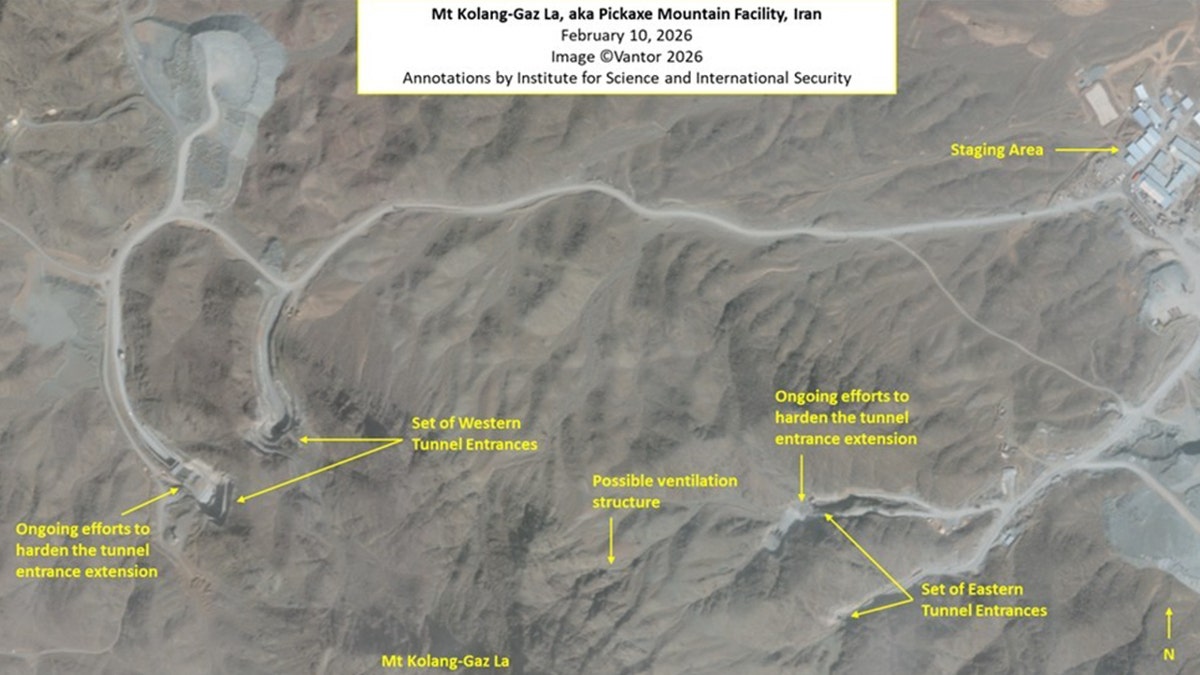
Imagery shows Iranian military facility being buried and fortified. (Images via Vantor with annotations from ISIS )
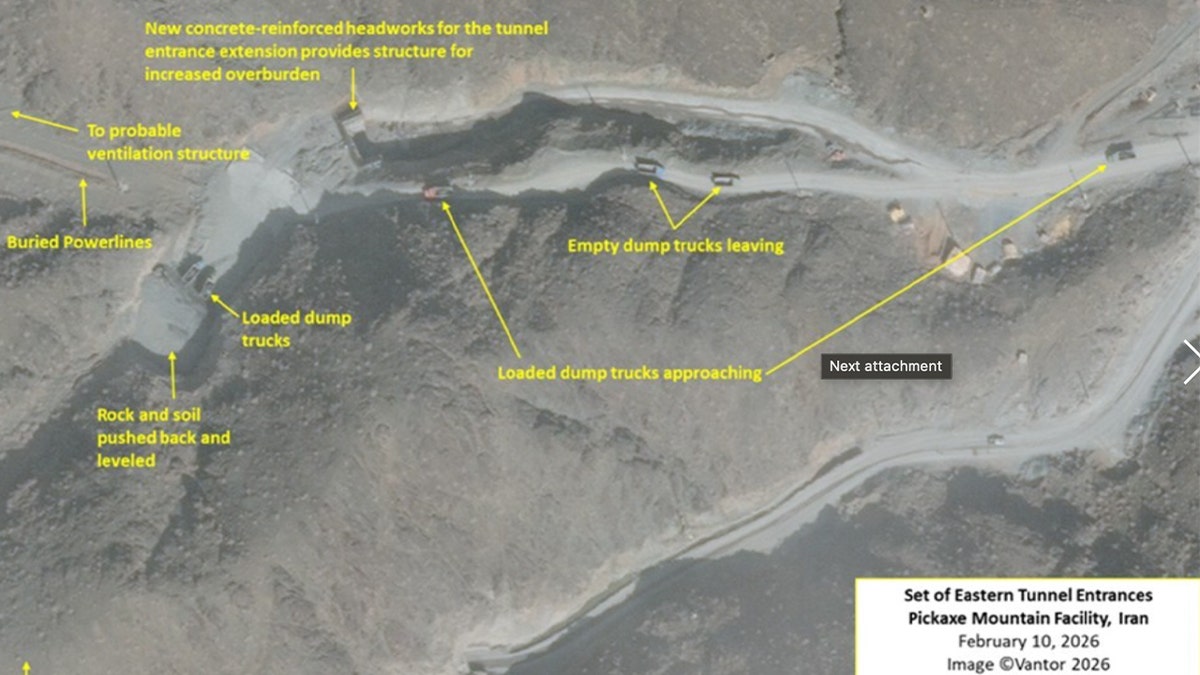
Dump trucks coming and going near entrances to military sites. (Images via Vantor with annotations from ISIS )
Further depth is provided by long-range bombers. B-2 Spirit stealth bombers, operating from Whiteman Air Force Base with aerial refueling, are capable of 30-hour round-trip missions. They are the only platforms configured to deliver the 30,000-pound GBU-57 Massive Ordnance Penetrator (MOP) against deeply buried targets.
Senior U.S. officials have disclosed that the Pentagon is preparing for "sustained, weeks-long operations" if conflict erupts — surgical Operation Midnight Hammer strikes conducted in June 2025.
Defense analysts say that timeline reflects the realities of munitions burn rates and forward-positioned stockpiles.
In high-intensity conflict simulations, forward-positioned precision munitions can be significantly depleted within roughly three to four weeks, depending on sortie tempo and target density. After that point, forces would rely increasingly on resupply from the continental United States — a process that can take additional weeks to scale into a full maritime logistics bridge.
Operations may not come to a halt, but campaign duration would depend heavily on replenishment cycles and industrial production, not just aircraft availability.
SCOTT BESSENT SAYS IRAN UNDERSTANDS 'BRUTE FORCE' AS TRUMP WEIGHS OPTIONS AMID NUCLEAR STANDOFF
Notably absent is the kind of troop buildup associated with a ground invasion.
There are no large-scale Army combat formations staging in Kuwait or Iraq for an occupation. The emphasis remains on stand-off strikes and precision airpower — a campaign designed to degrade targets from a distance rather than seize and hold territory.
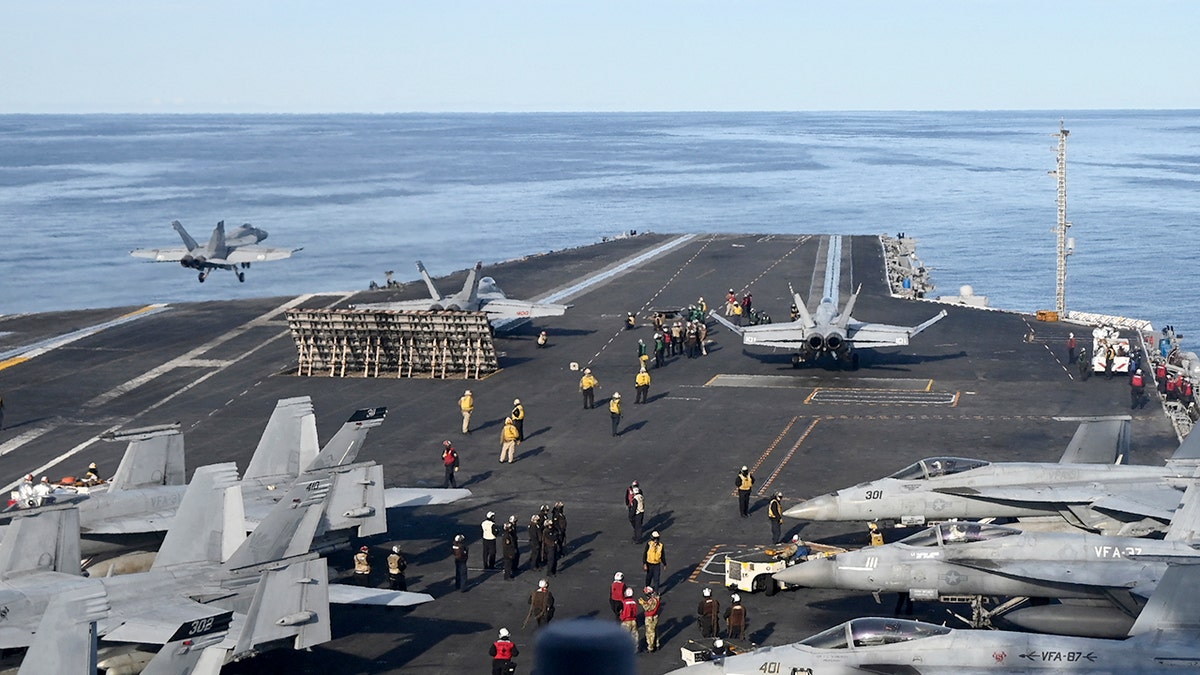
A F-18E fighter jet takes off from aircraft carrier USS Gerald R. Ford as it sails during NATO Neptune Strike 2025 exercise on Sept. 24, 2025 in the North Sea. (Jonathan Klein/AFP via Getty Images)
That distinction carries political weight.
A January 2026 Quinnipiac University poll found that 70% of American voters oppose a direct war with Iran, with even higher resistance to deploying ground troops. "Talk of the U.S. military potentially intervening in Iran's internal chaos gets a vigorous thumbs down, while voters signal Congressional approval should be a backstop against military involvement in any foreign crisis," said Quinnipiac analyst Tim Malloy.
Iranian officials have warned that U.S. bases in Saudi Arabia, the UAE and Turkey would be targeted if Washington launches an attack. Senior Iranian military figures have said any U.S. strike would be treated as "all-out war."
In response, the U.S. has distributed Patriot and THAAD missile defense batteries across regional hubs to shield its assets from potential missile retaliation.
Despite the military posture, talks are ongoing. Iranian officials have said they will return within weeks with additional proposals aimed at narrowing gaps in negotiations.
President Trump has framed the moment in blunt terms.
"We have to make a deal, otherwise it's going to be very traumatic, very traumatic," Trump said this week, warning that Iran would face consequences if diplomacy collapses.
CLICK HERE TO DOWNLOAD THE FOX NEWS APP
"The presence of so much firepower in the region creates a momentum of its own," said Susan Ziadeh, a former U.S. ambassador. "Sometimes that momentum is a little hard to just put the brakes on."
The force now in position — from dual carriers to stealth bombers — is structured not for a single weekend strike, but for endurance.
Whether it is used, and for how long, will depend on decisions still unfolding at the negotiating table.
https://www.foxnews.com/politics/built-weeks-war-inside-firepower-us-has-positioned-middle-east













Comments
0 comment